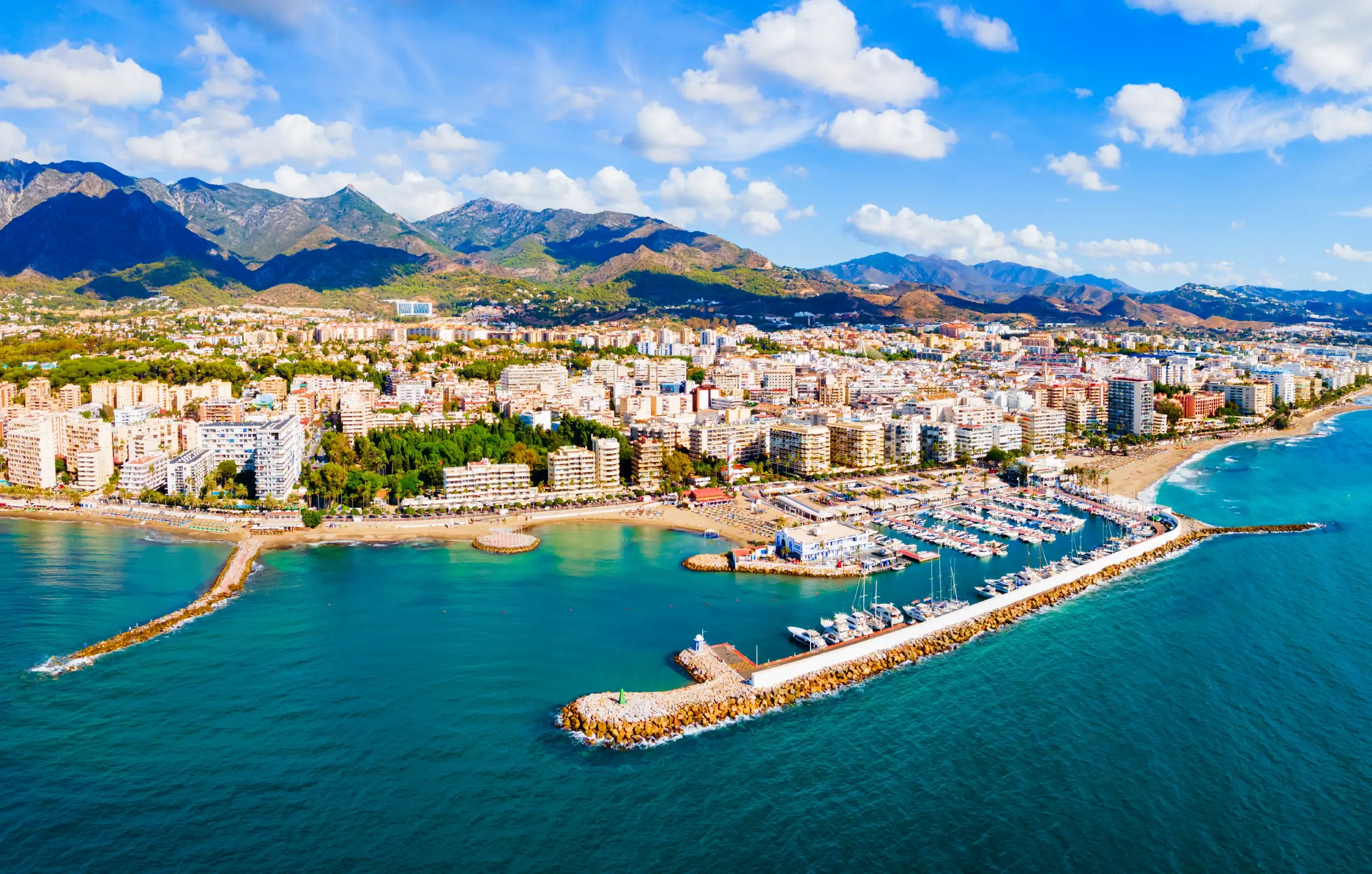
Marbella and the wider Costa del Sol have never relied on sunshine alone. Their international appeal has been built on a combination of climate, accessibility, lifestyle, hospitality and a long-established property market.
Today, a new wave of both private and public investment is strengthening those foundations and helping the region retain its position as one of Europe’s most desirable places to visit, live and own property.
From landmark luxury developments to airport expansion, water infrastructure and improved healthcare, the latest initiatives reveal a destination investing not only in attracting visitors, but also in becoming a better place for its permanent, seasonal residents and visitors alike.
For international buyers considering property for sale on the Costa del Sol, this broader investment picture matters. A desirable home is only one part of the decision. Buyers also look at transport connections, essential services, environmental resilience and the long-term quality of the surrounding area.
One of the most eye-catching recent examples is the Saudi royal family’s proposed expansion of its Finca Al Riyadh estate on Marbella’s Golden Mile. The proposal covers up to 80 villas, including up to 50 residences classified as palaces. As reported in the Sur in English , according to municipal calculations reported in July 2026, the urban development operation is expected to generate a net €19.4 million for Marbella Town Hall, before any additional revenue from construction-related taxation. It may also bring wider economic benefits through construction, professional services, maintenance, security and local employment.
Although this is a private project, its significance extends beyond the boundaries of the royal estate. It confirms the continuing appeal of Marbella’s Golden Mile among some of the world’s wealthiest families and demonstrates the confidence that international capital continues to place in the area.
For anyone exploring luxury property in Marbella, the project is another indication that the town’s prime residential areas continue to command global interest. However, the future of the Costa del Sol depends on more than exclusive villas. Several other major investments will have an even broader impact on local people, holidaymakers and overseas homeowners.
Accessibility has always been one of the Costa del Sol’s greatest strengths. Málaga-Costa del Sol Airport connects the region with cities across Europe and increasingly with destinations further afield, allowing many international owners to reach their homes within a few hours.
Aena has now begun the process for a major reform and expansion of the airport (announced in July 2025), with an estimated overall investment of approximately €1.5 billion.
The project is expected to be the airport’s most ambitious transformation since Terminal 3 opened in 2010. Its initial phase is due to form part of Aena’s 2027–2031 investment programme.
The purpose is not simply to handle more passengers. The proposed work is also intended to improve the experience of travellers and airlines while creating sufficient capacity for future growth.
For the tourism sector, expanded airport facilities can support new routes, reduce pressure during peak periods and encourage greater numbers of year-round visitors. Hotels, restaurants, golf resorts, shops and leisure businesses all stand to benefit.
The implications for real estate on the Costa del Sol are equally important. Easy access is a major consideration for buyers looking for a holiday home in Spain, particularly owners who intend to travel frequently rather than remain for one long annual stay.
Improved international connectivity can widen the area’s potential pool of buyers, support demand for holiday rentals and make permanent relocation more practical for digital nomads and professionals whose work continues to involve regular overseas travel.
For anyone considering whether to buy an apartment on the Costa del Sol or purchase a larger permanent residence, convenient air connections can have a direct influence on the area they choose to live in.
At the private-investment end of the spectrum, the planned Four Seasons Marbella resort represents one of the most significant hospitality and branded-residential projects on the Mediterranean coast. In April 2026, developers Immobel and Fort Partners announced that they had acquired land for the development. This moved the long-awaited project into what the developers described as a clearer and more executable phase.
The plans include a 105-room Four Seasons hotel, approximately 40 apartments, 54 townhouses and 33 villas. Beach clubs, restaurants, wellness amenities, sports facilities and cultural and educational elements are also envisaged across a beachfront site of approximately 32 hectares. Residential sales are currently planned to begin in 2027.
This is significant because international hotel brands bring more than a recognisable name. Branded residences typically combine private ownership with hotel-style services, professional management, security and extensive amenities. Their arrival reflects changing expectations at the upper end of the market. Buyers considering luxury villas for sale in Marbella are increasingly seeking a complete lifestyle proposition rather than a property alone.
The Four Seasons project may also influence the wider destination by encouraging other hotels, developers and service providers to raise their standards. It is likely to create employment, attract affluent visitors and reinforce East Marbella’s profile as an important high-end residential area.
It may stimulate interest in the nearby new developments in Marbella, particularly among international buyers who value modern design, managed services and access to resort-style facilities. Rather than replacing Marbella’s established character, projects of this nature can broaden Marbella’s appeal and help it compete with other luxury destinations such as the Côte d’Azur, Miami and Dubai.
Investment in water infrastructure protects the region’s future
Some of the most important investment taking place on the Costa del Sol will be largely invisible to visitors, yet is crucial for the growing population.
In July 2026, the European Investment Bank and Acosol signed the first €75 million tranche of an approved €175 million loan to improve water infrastructure across the western Costa del Sol.
The programme will upgrade drinking-water supply, sanitation and wastewater systems in 11 municipalities, including Marbella, Estepona, Benahavís, Mijas, Fuengirola and Benalmádena. It is expected to benefit approximately one million residents, rising to more than 1.4 million people during the summer season.
Planned work includes the refurbishment of more than 30 kilometres of drinking-water pipelines, replacement of sections of the sewerage network, improvements to wastewater-treatment plants and the expansion of reclaimed-water systems.
Investment is also planned at Marbella’s desalination plant, including measures to increase energy efficiency and generate renewable energy for its own use. For residents, this means more reliable and efficient essential services. For tourism businesses, golf resorts and residential communities, it contributes to greater resilience during drought and periods of intense seasonal demand.
Water security is also becoming increasingly relevant to people looking to buy property in Marbella or elsewhere on the Costa del Sol. Buyers naturally focus on location, views and design, but infrastructure and environmental management are central to the long-term sustainability of any property market. This is especially important for purchasers comparing villas for sale on the Costa del Sol, gated residential communities and homes with landscaped gardens and private pools, all of which depend on responsible long-term water planning.
A region that invests in reducing water loss, increasing reuse and adapting its infrastructure to climate pressures is better prepared to protect both its quality of life and its economic future.
The most encouraging aspect of the current investment cycle is its wide spectrum. Luxury developments such as Four Seasons Marbella and the Saudi royal estate generate international attention. Málaga Airport supports accessibility and visitor growth. Water investment addresses environmental resilience. Together, they create a stronger proposition for residents, businesses, holidaymakers and international investors.
Birgitte Weber, owner of Weber Estates, describes the benefits in personal terms:
“Marbella’s enduring appeal comes from far more than its climate and coastline. Continued investment in infrastructure, healthcare, hospitality and public services is strengthening the quality of life that attracts people from around the world. For property buyers, this creates confidence that the Costa del Sol is not only a wonderful place to enjoy today, but a destination with a secure future.”
Her observation reflects an important distinction. People rarely buy a home on the Costa del Sol based solely on its square metres. They are buying access to a wider lifestyle: beaches, mountains, outdoor living, Andalusian culture, international communities and convenient connections to the rest of Europe.
Continued investment helps protect and improve that lifestyle. It also gives buyers greater confidence that Marbella and the Costa del Sol are planning for the future. New construction may capture the headlines, but infrastructure, healthcare, water management and transport are what enable a successful destination to continue growing without losing its functionality.
No property purchase should be viewed as guaranteed to rise in value, and buyers should always obtain independent legal and financial advice. Nevertheless, sustained public and private investment bolster long-term demand for Marbella real estate and the wider Costa del Sol property market.
People looking for a holiday apartment, a permanent home, a luxury villa or a property investment on the Costa del Sol, the message is clear: the region is not standing still.
Marbella is building on the qualities that made it internationally famous while investing in the systems and services needed for its next chapter. That balance between lifestyle, infrastructure and private ambition is precisely what can help the Costa del Sol remain one of Europe’s leading destinations for decades to come.
To provide the best experiences, we and our partners use technologies like cookies to store and/or access device information. Consenting to these technologies will allow us and our partners to process personal data such as browsing behavior or unique IDs on this site and show (non-) personalized ads. Not consenting or withdrawing consent, may adversely affect certain features and functions.
Click below to consent to the above or make granular choices. Your choices will be applied to this site only. You can change your settings at any time, including withdrawing your consent, by using the toggles on the Cookie Policy, or by clicking on the manage consent button at the bottom of the screen.